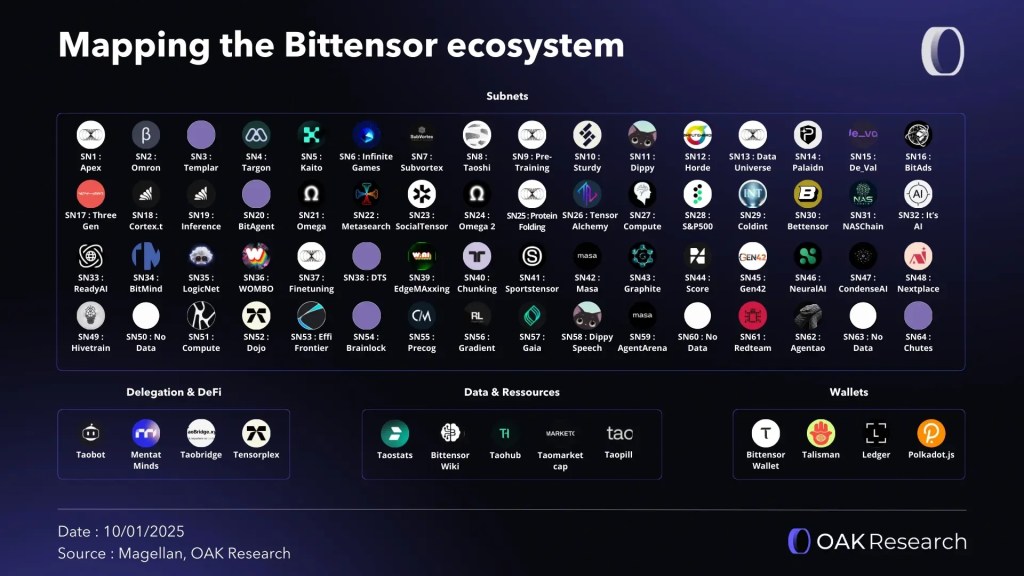
• Understanding Subnets: The Building Blocks of Bittensor

    Imagine a network where artificial intelligence models operate like independent startups—each with its own mission, goals, and potential to create value. That’s exactly how Bittensor subnets work. They are the building blocks of the decentralized AI ecosystem, providing specialization, scalability, and investment opportunities in a rapidly evolving landscape.


    🌐 What Are Subnets?

    In the Bittensor ecosystem, a subnet is a specialized section of the network focused on a particular AI task. Instead of having one giant model trying to do everything, subnets allow AI models to specialize. Think of them as mini-ecosystems within the broader Bittensor network.

    Each subnet operates like an independent AI startup. Investors can participate early, contributors can train models, and validators ensure outputs are accurate and valuable. The best-performing subnets earn more TAO rewards, and the growth of a subnet is reflected in the value of its contributions.

    This structure provides several advantages:

    1. Specialization – Each subnet can focus on a specific AI domain, from drug discovery to autonomous AI agents.
    2. Scalability – As new problems arise, new subnets can launch without affecting the rest of the network.
    3. Investment Potential – Early participation in promising subnets is like getting in on the ground floor of AI startups.

    🔍 How Subnets Work

    Subnets rely on three key players:

    • Miners/Contributors – They provide data and computational resources to train AI models within a subnet.
    • Validators – They check outputs for accuracy, ranking peers and determining TAO rewards.
    • Delegators – Investors can delegate TAO to a subnet, effectively supporting promising models and earning rewards based on performance.

    The performance of each subnet is dynamic. Models compete and collaborate, creating a constantly evolving ecosystem where innovation is rewarded.


    💡 Notable Subnets

    NOVA – Drug Discovery

    NOVA focuses on AI-driven drug discovery. By training models on biochemical data, NOVA accelerates the search for new treatments and therapeutics. Investors participating in NOVA are effectively gaining early exposure to breakthroughs in healthcare AI, with the upside tied to the subnet’s success in producing valuable models.

    Ridges – AI Agents Competing with Centralized Giants

    Ridges is a subnet where AI agents tackle complex tasks that centralized AI companies dominate today. From autonomous problem-solving to natural language understanding, Ridges allows contributors to test models in a competitive, decentralized environment. Early investors can stake TAO in Ridges, gaining exposure to potentially disruptive AI applications before large corporations scale them.

    These examples show that subnets aren’t just abstract technical constructs—they are AI startups you can interact with, contribute to, and invest in.


    ⚡ Why Subnets Matter for Investors

    Subnets turn Bittensor into more than a network—they create a decentralized investment playground:

    • Early Access – Supporting a subnet early gives you exposure to innovation before it becomes mainstream.
    • Diversification – You can allocate TAO across multiple subnets, spreading risk across different AI domains.
    • Performance-Based Rewards – The better a subnet performs, the higher the TAO rewards for contributors and delegators.
    • Transparency – All contributions, performance metrics, and rewards are recorded on-chain, ensuring trust.

    Investing in subnets is like backing multiple AI startups at once, without needing insider access or millions of dollars.


    📈 How to Participate

    Getting involved in subnets is straightforward:

    1. Choose a Subnet – Look at the focus area (e.g., NOVA, Ridges) and assess your interest or expertise. Check out these links to explore the vast list of subnets.
    1. Contribute or Delegate – If you have data or compute power, you can train models. If you want a more passive role, delegate TAO to validators supporting the subnet.
    2. Monitor Performance – Each subnet’s success is dynamic. Track contributions, peer rankings, and TAO rewards.
    3. Diversify Across Subnets – Spread your stake to reduce risk and increase exposure to different AI domains.

    The combination of active contribution and strategic delegation allows both investors and learners to participate meaningfully in the ecosystem.


    🔹 Key Takeaways

    • Subnets are the building blocks of Bittensor, each focusing on specialized AI tasks.
    • Early participation = early exposure, much like investing in AI startups.
    • NOVA and Ridges highlight the diversity and potential impact of subnets.
    • Contributors, validators, and delegators all play roles in driving subnet success and earning rewards.

    By understanding subnets, investors and AI enthusiasts can see how Bittensor decentralizes intelligence creation, opens investment opportunities, and empowers global collaboration.

    Bittensor isn’t just a network—it’s a decentralized launchpad for the next generation of AI innovation. Subnets give you the chance to get in on the ground floor and ride the growth of decentralized AI from day one.
  • Two trends are reshaping our world: artificial intelligence and crypto. AI is advancing at lightning speed, and crypto continues to push the boundaries of finance and ownership. But these two worlds often feel disconnected—AI controlled by big corporations, crypto flooded with hype and noise.

    Then I discovered Bittensor—and everything changed.


    The Missing Link Between AI and Crypto

    Bittensor is a decentralized network where anyone can contribute to the growth of AI and be rewarded with real economic value. Instead of a handful of corporations owning the future of intelligence, Bittensor creates a marketplace for AI models.

    It’s AI and crypto finally working together in a way that’s open, transparent, and rewarding for participants.


    Why I Started This Blog

    When I started researching Bittensor, I realized two things:

    1. The potential here is massive—for both technology and investors.
    2. The information is scattered, technical, and hard to follow.

    So I created this blog to make Bittensor simple, exciting, and accessible. Each week, I’ll break down the ecosystem in plain English: subnets, validators, Dynamic TAO, staking, and more.

    If you’re looking for a clear guide into decentralized AI, you’re in the right place.


    The Exciting Part: Dynamic TAO (DTAO)

    Here’s what really excites me: Dynamic TAO, or DTAO.

    In traditional investing, if you want exposure to AI startups, you need insider access or huge capital. By the time the public gets a chance, most of the upside is gone.

    DTAO changes that. It allows investors to dynamically allocate their TAO across the network, adapting to where value is being created. Instead of passively holding tokens, you’re actively participating in the growth of AI innovation.

    Think of it like being able to invest in the next wave of AI startups—but in a decentralized, global, and open way. For once, everyday investors don’t have to sit on the sidelines.


    What to Expect Here

    In the coming weeks, I’ll cover:

    • Foundations: What Bittensor is and how it works.
    • Deep Dives: Subnets, validators, and the mechanics of TAO.
    • Investor Guides: How to buy TAO, how to stake, and how to use DTAO.
    • Opportunities + Risks: What makes Bittensor unique, and what you should watch for.

    Final Thoughts

    AI is accelerating. Crypto keeps rewriting the rules of finance. And Bittensor sits at the intersection of both revolutions.

    We’re still early—really early. That’s what makes this moment so exciting.

    I’m not here to hype; I’m here to explore, explain, and share why Bittensor deserves attention.

    Welcome to the journey.

    👉 Start here: What is Bittensor? The Beginner’s Guide to AI + Crypto

  • What is Bittensor? The Beginner’s Guide to AI + Crypto

    Imagine being part of a network that rewards you—financially—for helping train artificial intelligence. Not working for a big tech company, but contributing from your own device, dataset, or through validating others’ work—and earning real crypto in return. That’s the idea behind Bittensor.

    🌐 Why Bittensor Matters for Investors and Learners

    Traditional AI development is centralized. Big corporations are training massive models, using vast datasets, and mostly controlling who gets to use the intelligence. This centralization causes:

    • Cost and access bottlenecks (AI is expensive to build and serve).
    • Biases or lack of diversity (narrow training sets; limited perspectives).
    • Slow innovation outside a few dominant players.

    Bittensor’s goal? To decentralize the creation, validation, and exchange of intelligence. It builds a marketplace where many different AI models contribute, compete, and are rewarded. Anyone with skills, data, or computational resources can join. The network is powered by its native token TAO.


    🧩 Core Components: How Bittensor Works

    Here are the main pieces you need to understand:

    1. Peers (Miners/Contributors)
      Participants who supply data, compute power, or model training. These peers train AI models on their own datasets, then interact with other peers to test / validate / produce useful signals. Their performance (how “useful” their models are to others) determines their reward.
    2. Validators
      Validators check whether the outputs from miners/peers are accurate and trustworthy. They help keep the network honest. Because performance is judged by other peers, validation is essential to ensure the system doesn’t become dominated by bad actors or dishonest collaborations.
    3. Subnets
      Think of subnets as specialized “zones” or “sub-networks” within Bittensor that focus on specific tasks or modalities (text, image, speech, etc.). These allow specialization. For example, a subnet for language translation vs. a subnet for image recognition. This helps scale and diversify the types of AI being produced.
    4. TAO Token
      TAO is the native cryptocurrency of Bittensor. It serves as the incentive mechanism: peers and validators earn TAO for contributing useful computations or checking others’ work. It’s how the network rewards value. TAO is also used to measure stake and influence: peers that hold more TAO (or are more trusted by others) have greater weight.
    5. Incentive / Peer-Ranking / Anti-Collusion Mechanics
      To ensure fairness and prevent manipulation, Bittensor includes a system of peer ranking, bonds, consensus measures, and weight adjustments. Peers are ranked based on their value (how much they contribute) and stake. There’s also guardrails to reduce rewards from groups trying to game the system.

    🔍 Why this matters for Investors & Learners

    Here are some reasons Bittensor could be a compelling investment + learning opportunity:

    • Early in the game: Decentralized AI is still fairly nascent; platforms like this have a chance to grow fast.
    • Multiple ways to earn: You could participate as a miner, validator, or even via staking/dTAO (delegated TAO) later.
    • Diversification: Bittensor blends AI + crypto. For those who believe AI is going to dominate tech’s future, getting exposure via this decentralized layer could be strategic.
    • Open innovation: You’re not limited to what a company’s roadmap dictates—you can also contribute, build on subnets, or even launch your own models.

    ⚠️ Things to watch / Potential Risks

    Of course, with upside comes risk. Some of the things an investor or learner should consider:

    • Technical complexity: Understanding how subnets, validators, data quality, and peer ranking work takes time. Errors or poor contributions might hurt reputation or returns.
    • Competition & adoption: Success depends heavily on whether the network attracts quality data sets, model contributors, and validators. If adoption is low, network effects might lag.
    • Tokenomics & inflation: Because rewards and stake influence how much TAO you get, inflation, staking requirements, and consensus thresholds matter. These parameters can change, which could affect returns.
    • Infrastructure & cost: If you’re running or contributing models, there could be compute costs, data costs, bandwidth issues. You’ll need to consider whether your investment of time/resources pays off.

    🚀 How to Get Started (Next Steps)

    Here are some simple steps you can take if you want to explore Bittensor seriously:

    1. Learn more – The official Bittensor whitepaper and community sites such as Bittensor.ai, Taostats.io & Tao.app are great resources.
    2. Join the community – Discord, Telegram, etc., to follow developments, see what subnets are active, and what the peer/validator experiences are like.
    3. Setup a wallet – You’ll need somewhere safe to hold TAO once you buy or earn it.
    4. Decide on your role – Will you contribute compute, build models, validate, stake, or simply hold? Each path has different tradeoffs.
    5. Watch regulations & security practices – As with any crypto project, doing your own research, securing your private keys, understanding regulatory issues is crucial.

    📝 In Summary

    Bittensor is building more than just another AI project. It’s creating a new kind of market—a decentralized, peer-to-peer intelligence market where AI models compete, validate, collaborate, and earn based on their merit. For investors, it’s a chance to be part of something emerging, where value is tied not just to token price but to real contributions and innovation. For learners, it’s a space where you can get involved, build knowledge, and perhaps influence the direction of AI in a more open, transparent system.

    If you’re curious about AI + crypto, Bittensor is definitely one to watch—this is just the beginning.